Research
Looking for cosmic echoes of gravitational waves through lensing
Gravitational waves were first predicted by Einstein in 1915, and their first detection in 2015 opened a new window on the Universe. Massive astrophysical objects like black holes and neutron stars in close binaries can dance around one another until they collide so strongly they cause the Universe itself to ripple with the aftershocks. The LIGO, Virgo, and KAGRA gravitational-wave detectors listen for these ripples. When a wave passes through the detectors, we can identify it as a gravitational-wave event.
Another pillar of Einstein’s General Relativity was gravitational lensing: when a massive object, like a galaxy, comes between a bright object and the observer, the light from the source can bend and curve in the gravitational well of the foreground galaxy. These systems are known as gravitational lenses, because the galaxy in front acts like a lens by bending and focusing the light and creating multiply imaged copies of their source.
Since both gravitational waves and gravitational lensing come from General Relativity, we have to ask: is it possible for gravitational waves to be lensed too? And the answer is — yes. If a gravitational-wave event happens behind another galaxy, we can see multiple copies of the same gravitational-wave event. Though not yet proven, the LIGO-Virgo-KAGRA collaboration look for these echoes in each observation run in the hopes of detecting and confirming the first lensed gravitational-wave event. Once detected, we expect lensed gravitational waves to have applications across astrophysics, including cosmology, dark matter, black hole physics, or tests of general relativity.
I have been a member of the LIGO-Virgo-KAGRA collaboration and its Lensing group since 2023, and became lead of the GOLUM strong-lensing inference pipeline in 2024. As lead, I led the GOLUM analyses as part of the GWTC-4.0 Lensing paper, included specially driven analyses of highlighted events such as GW230529, GW2308114, and GW231123. As the highest Bayes factor in favour of lensing found to date, the dedicated lensing follow-up of GW231123 were also published as part of the Lensing paper itself. I continue to be involved in the effort for GWTC-5.0 and beyond as co-lead of LINK (the merger of GOLUM and Gravelamps) pipeline, as well as a member of the Editorial Team of the subsequent Lensing paper.
How do we find black holes, and what can they tell us?
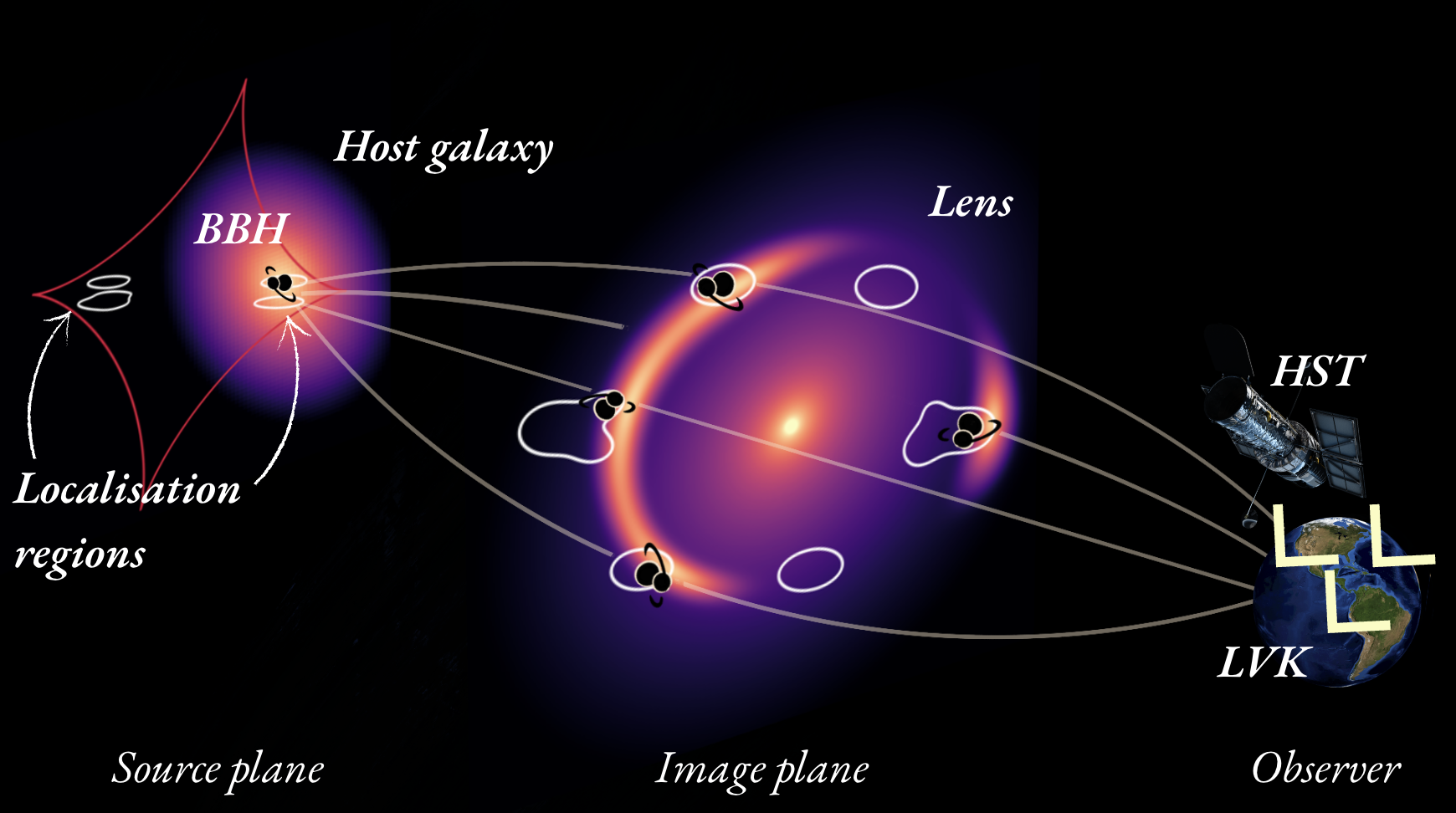
Gravitational-wave lensing already opens new avenues for astrophysics, but the one I am excited about is black hole astrophysics, and understanding these elusive objects. Black holes are fascinating, and binary black holes are some of the most extreme cosmic objects we know of, but strangely little is known about how they form, where, and what their relationship is to their environments and host galaxies. One of the reasons is that we cannot find black holes. We can hear these binaries with incredible precision, thanks to the gravitational-wave detectors, but we cannot see them. Locating them in the Universe relies entirely on triangulation, like a GPS, but since we only usually have 2 or 3 detectors online, the sky patches we can localise black hole binaries to remain massive. They contain thousands of galaxies, so we cannot tell which one they came from.
But what if there was a way to locate them to a single host galaxy?
If we know a gravitational-wave event, coming from a merging pair of black holes, was lensed, we can assume that if the black holes came from stars, they resided — or their remnant now resides — inside a galaxy. And if the gravitational waves are lensed, then the host galaxy’s light should also be lensed by the same object. Telescopes like HST, JWST, or Euclid, routinely search for lenses in the sky and image them. If we were to find a lensed image, and deteremine the properties of the lensing object, we could then try to match that lens to the lensed gravitational-waves. If the lensed waves match the lensed image, then we know that the binary black hole must have been lensed by that lensing galaxy: we have found the host galaxy.
In fact, multi-messenger lensing like this (since we are combining both electromagnetic and gravitational ‘messengers’) has recently gained a lot of interest across astrophysics for its potential applications, both for binary black holes and neutron stars. I am specifically interested in studying black holes in this way. Because of the localisation problem, if we are able to find the host galaxy of the binary black hole, we have already uniquely identified the galactic host in a way that unlensed gravitational-wave events cannot. But by going a step further, and combining both datasets to do lens reconstruction (the method by which we determine the structure of a lensing galaxy and what the background galaxy looks like), we can also reconstruct the original position of the binary black hole. And this offers an unprecedent way to study these dark compact binaries. A lot of its potential applications are still unknown, because of how young the field is.
I want to use multi-messenger lensing to study the origins of binary black holes, and the environments in which they form. In a new study, I showed that if we can localise a binary black hole to the galactic centre of its host, we can tell that it has to have formed by methods that only act in the galactic centre, rather than methods that could otherwise occur elsewhere in the galaxy and coincidentally match the centre. This is the first ever time that the formation environments and channels of binary black holes have been studied through direct localisation, and multi-messenger lensing lets us do that.
I am currently studying ways in which to leverage multi-messenger lensing further to study the origins of these binaries in more detail, as well as further understanding the relationship between binary black holes and their host galaxies, as well as the larger populations of black holes in our Universe.
Bayesian inference: How we achieve this
Studying lensed gravitational waves and electromagnetic images of lensed galaxy systems is a complex inference problem, with high-dimensional models and expensive waveform and lens equation computations. As such, developing frameworks capable of taking both gravitational-wave and EM data is imperative. I am the creator and lead developer of silmarel (github), a pipeline designed to handle multi-messenger data using statistical and mathematical approximations as a way to make the computation feasible. I intend to develop silmarel to full deployment on real candidate lensed GW events by GWTC-7.0.
While silmarel offers one solution, it is by no means the sole solution. I am actively involved in other projects and collaboration seeking to develop both rapid inference methods geared towards multi-messenger lensing, as well as improvements in silmarel to bring us ever closer to full, complete multi-messenger inference.
I am also actively involved in development work within the LVK’s Lensing group. I contributed to the testing and analyses of LensingFlow. I continue to be involved in analysis and development efforts in the LVK in the search for lensed gravitational waves.
Other research
As part of my Master’s project, I studied the binary star system HD 181793. We identified the binary as a rare heartbeat binary, where the chemically peculiar primary is partially eclipsed and undergoes tidal stretching that results in a pattern resembling a cardiogram due to the eccentricity of the orbit.